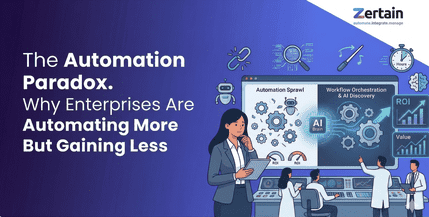
The Automation Paradox: Why Enterprises Are Automating More But Gaining Less

Here's a number that should concern every technology leader: the global hyperautomation software market hit $720 billion in 2023, and Gartner reports that 80% of large enterprises are increasing or sustaining their automation investments year over year. Yet Forrester predicts that fewer than 15% of firms will actually activate agentic features in their intelligent automation suites in 2026. The gap between spending on automation and gaining from automation has never been wider.
Welcome to the automation paradox—where more automation doesn't translate to more value. Where the volume of automated workflows has exploded, but enterprise automation ROI has flatlined. And where the organisations that win aren't the ones automating the most, but the ones automating the right things, in the right order, for the right reasons.
The Volume Trap: How Automation Sprawl Kills ROI
Most enterprises fell into automation sprawl the way they fall into most things: opportunistically. A team here automates an invoice approval. Another team there scripts a data reconciliation. Before long, there are dozens—sometimes hundreds—of automated workflows running across siloed tools, platforms, and departments. On paper, this looks like digital transformation. In practice, it's chaos wearing a dashboard.
The problem isn't that these automations don't work. Most do exactly what they were designed to do. The problem is that nobody asked whether they were the highest-value things to automate. What you end up with is a high volume of low-impact automations—each one saving minutes, while the processes that actually bleed hours, revenue, and human potential remain untouched.
This is the volume trap: optimising at the edges while the core stays manual. And fewer than 20% of organisations have mastered the measurement of their hyperautomation initiatives, according to Gartner—meaning most enterprises can't even tell you whether their automation investments are delivering returns.
Why "Automate Everything" Is a Failing Hyperautomation Strategy
There's a seductive simplicity to the "automate everything" mantra. It sounds bold and modern. It's also a recipe for technical debt, integration nightmares, and disappointed boards.
The enterprises we work with at Zertain consistently hit the same wall: they've invested in best-of-breed platforms—workflow engines, RPA tools, iPaaS solutions, enterprise scheduling systems—but these platforms operate in parallel rather than in concert. Each one automates its slice, but nobody is orchestrating the whole.
The result? Automation silos. You've replaced manual silos with faster silos, but silos nonetheless. Data still doesn't flow end-to-end. Handoffs still break. And the total cost of ownership climbs because now you're maintaining not just the processes, but a sprawling automation estate that nobody fully understands. This is why so many digital transformation initiatives fail to deliver—not because the technology is wrong, but because the strategy is missing.
The Discovery Gap: Why AI-Powered Automation Discovery Changes Everything
Here's the uncomfortable truth most technology leaders already suspect but rarely say out loud: the biggest automation opportunity in your enterprise isn't the one you're working on. It's the one you haven't found yet.
Most automation programmes start with what's visible—the processes teams complain about, the workflows leadership happens to know are manual. But the highest-value opportunities are often buried in the spaces between systems, in the handoffs nobody owns, in the batch processes that run overnight and break silently.
This is the discovery gap. And it's where AI-powered automation discovery is making a genuine difference—not by automating more, but by helping organisations see where automation would actually move the needle.
The shift is subtle but significant: from "what can we automate?" to "what should we automate?"
Workflow Orchestration: The Missing Layer in Enterprise Automation
If the first wave of enterprise automation was about doing things faster, the next wave needs to be about doing things together. The organisations breaking through the automation paradox aren't adding more bots or workflows. They're investing in workflow orchestration—the ability to coordinate across platforms, systems, and teams in a way that's intelligent, observable, and adaptable.
Think of it this way: a symphony orchestra doesn't get better by adding more musicians. It gets better with a conductor who knows the score. Enterprise automation needs the same—a layer of intelligence that understands the full landscape, manages dependencies, handles exceptions, and continuously optimises.
This is what hyperautomation strategy was always supposed to deliver. Not a technology category, but a capability—the ability to discover, design, orchestrate, and govern automation as a unified discipline. It's the difference between having 200 bots and having an automation strategy.
Five Questions to Diagnose Your Enterprise Automation ROI
If the automation paradox resonates with your organisation, here are five questions worth asking:
1. Do you know your automation estate? How many automated workflows run across the organisation today, and who owns them? If the answer is "we're not sure," that's the first problem.
2. Are you automating for impact or activity? Is there a clear link between your automation roadmap and measurable business outcomes—revenue, cost, risk, speed? Or are you automating because it's on someone's OKR?
3. How much runs in automation silos? If your workflows can't communicate across platforms, you don't have enterprise automation—you have islands.
4. What's your discovery process? How do you identify what to automate next? If the answer is "people raise requests" or "we brainstorm in workshops," you're leaving the highest-value opportunities undiscovered.
5. Who's the conductor? Workflow orchestration isn't a platform—it's a practice. Who in your organisation owns the end-to-end hyperautomation strategy, and do they have the tools and authority to execute?
Breaking Through: From Automation Sprawl to Automation Strategy
The automation paradox isn't a technology problem. It's a strategy problem dressed in technology's clothes. The enterprises that will lead the next decade aren't the ones with the most automations—they're the ones with the most intentional automation.
That means shifting from volume to value. From isolated tools to end-to-end workflow orchestration. From reactive automation requests to AI-powered automation discovery. And from measuring success by how much you've automated to measuring it by how much better the business actually performs.
At Zertain, this is the work we do every day—helping enterprises move from automation sprawl to automation strategy. With 15+ years of experience across workflow orchestration, enterprise scheduling, iPaaS, and AI-driven discovery, we partner with organisations to build hyperautomation programmes measured by outcomes, not activity.
The question isn't whether you should automate more. The question is whether you're ready to automate smarter.
What’s a Rich Text element?
The rich text element allows you to create and format headings, paragraphs, blockquotes, images, and video all in one place instead of having to add and format them individually. Just double-click and easily create content.
Static and dynamic content editing
A rich text element can be used with static or dynamic content. For static content, just drop it into any page and begin editing. For dynamic content, add a rich text field to any collection and then connect a rich text element to that field in the settings panel. Voila!
How to customize formatting for each rich text
Headings, paragraphs, blockquotes, figures, images, and figure captions can all be styled after a class is added to the rich text element using the "When inside of" nested selector system.