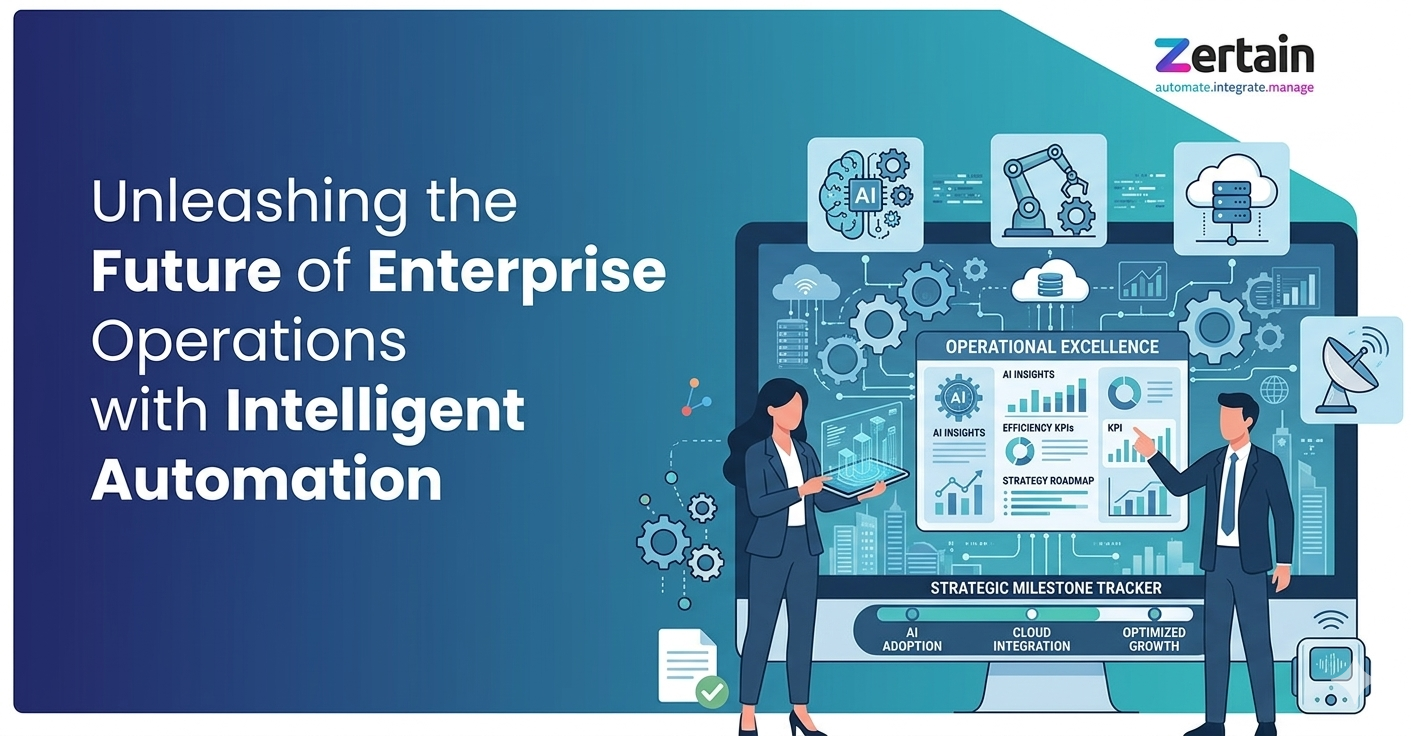
The Future of Enterprise Operations: From Manual Processes to AI-Orchestrated Automation

Why Are Enterprise Operations Still Broken in 2026?
For the past two decades, enterprise technology strategy followed a predictable pattern: buy best-of-breed applications for each function, hire specialists to manage them, and build custom integrations to make them talk to each other. It worked — until it didn't.
According to a 2024 MuleSoft Connectivity Benchmark report, the average enterprise now uses over 1,000 discrete applications — yet only 29% of them are integrated. The result is a staggering amount of manual effort hidden inside every business process.
HR teams toggle between six systems to onboard a single employee. Insurance adjusters manually cross-reference damage images against cost tables spread across three platforms. Sales teams lose deals because pulling a simple invoice requires navigating two separate tools and waiting for someone in finance to respond.
The problem was never the individual applications. Each one is excellent at what it does. The problem is the negative space between them — the manual effort, the copy-paste workflows, the tribal knowledge about which system holds which data, and the constant context-switching that drains productivity. According to Harvard Business Review, knowledge workers spend an estimated 25% of their time searching for information across disconnected systems.
That era is ending. What's replacing it will reshape how enterprises operate for the next decade.
What Are the Three Waves of Enterprise Automation?
Enterprise automation has evolved through distinct phases, and understanding where we have been clarifies where we are headed.
Wave One: Point-to-Point Integration. Organisations connected systems with direct API integrations, custom middleware, and ETL pipelines. This worked for simple, predictable data flows but created brittle architectures. Every new application meant dozens of new integration points. Maintenance costs grew exponentially. A single API change could cascade failures across the business.
Wave Two: Platform-Based Integration. Integration platforms emerged to centralise connectivity. Pre-built connectors replaced custom code. Workflow designers replaced hand-written scripts. This dramatically reduced the cost and complexity of connecting systems, but the logic layer — deciding what happens when, and why — still required technical expertise. Business teams remained dependent on IT for every workflow change.
Wave Three: AI-Orchestrated Operations. This is where we are now. The current wave combines unified automation platforms with AI agents that understand business context, interact conversationally with users, and orchestrate multi-system processes autonomously. Gartner predicts that by 2026, more than 80% of organisations will have deployed AI-enhanced automation in their operations, up from fewer than 20% in 2022. The shift is not just technical — it is organisational. For the first time, the people closest to a business problem can interact directly with the systems that solve it, without needing to understand the underlying architecture.
What Does AI-Orchestrated Automation Look Like in Practice?
The concept is powerful but abstract. Here is what it looks like in practice across different enterprise functions.
Human Resources and Employee Onboarding. An HR coordinator asks a conversational AI agent to check the onboarding status for a new hire. The agent queries the ticketing system for open onboarding tasks, pulls the employee's current record from the HR platform, and returns a consolidated status update — all within seconds. If something needs updating, the coordinator confirms the change in natural language and the agent executes it across the relevant systems with full audit trails. No system-hopping. No manual reconciliation. According to SHRM, organisations that automate onboarding see new hire productivity increase by up to 50% in the first 90 days.
Insurance Claims Processing. A claims analyst receives a new case. Instead of manually collecting data from the CRM, looking up regional repair cost rates in a separate system, and comparing before-and-after damage photographs side by side, an AI agent handles the entire assessment workflow. It gathers claim details, retrieves cost benchmarks, analyses damage images using computer vision, calculates estimated repair costs, and generates a structured report — flagging any discrepancies for human review. McKinsey estimates that AI-driven claims processing can reduce assessment time by 30–50% while improving accuracy.
Sales Operations and Revenue Acceleration. A sales rep needs to convert a qualified lead, check the status of an outstanding invoice, and update an opportunity record. Rather than switching between CRM and finance systems, they interact with a single AI agent that handles all three actions conversationally. The rep stays focused on selling; the agent handles the operational overhead. Forrester research shows that sales teams using AI-assisted automation close deals 15–20% faster than those relying on manual processes.
Aged Care, Healthcare, and Regulatory Compliance. Staff at an aged care facility need to report a safety incident. An AI agent guides them step by step through the reporting process, ensures all required fields are captured according to regulatory standards (including ACQSC and NDIS frameworks), creates the incident record in the compliance system, and sends confirmation notifications — all while maintaining the documentation trail that regulators require.
These are not speculative scenarios. Organisations are deploying these capabilities today, and the results are measurable: faster process completion, fewer errors, reduced training time for new staff, and significantly lower operational overhead.
Why Does AI-Orchestrated Automation Matter More Than Previous Waves?
Every generation of enterprise technology promises transformation. What makes AI-orchestrated operations different from the hype cycles that preceded it?
It solves the last mile problem. Previous automation waves connected systems but still required humans to orchestrate the process. Somebody had to know which system to check, what data to pull, and how to interpret the results. AI agents close that gap by handling orchestration themselves, guided by business rules and domain knowledge embedded in the platform.
It scales without proportional headcount. Traditional operations scale linearly — more volume requires more people. AI-orchestrated operations scale logarithmically. Once an agent is configured for a workflow, it handles the first case and the thousandth case with the same speed and accuracy. The humans in the loop focus on exceptions and decisions, not routine execution. Deloitte's 2024 Global Intelligent Automation Survey found that organisations with mature automation programs achieved 3.5x more cost savings than those in early stages.
It democratises access to complex processes. When a business process requires navigating five systems, only specialists can execute it efficiently. When that same process is accessible through a conversational interface, anyone with the right permissions can drive it. This does not eliminate expertise — it redistributes it. Domain specialists encode their knowledge into agent configurations, and the entire organisation benefits.
It compounds over time. Each automated workflow generates data about how the process actually works — where delays occur, which exceptions are most common, how long each step takes. This data feeds continuous improvement. The platform gets smarter, the processes get faster, and the organisation's operational intelligence deepens with every interaction.
How Is the Enterprise Workforce Changing? From System Experts to Process Architects
The most underappreciated aspect of this transition is not technological — it is organisational.
In the current model, enterprises employ specialists who understand specific systems. There are CRM administrators, IT service management engineers, HR platform specialists, and ERP consultants. Their value is knowing how to operate individual tools. That value does not disappear, but it evolves.
In an AI-orchestrated model, the premium shifts to people who understand end-to-end processes and can design intelligent workflows that span multiple systems. The question changes from "how do I configure this system?" to "how should this business process work, and what should happen at each decision point?"
This creates a new role — part business analyst, part automation architect — that sits at the intersection of domain expertise and platform capability. The World Economic Forum's Future of Jobs 2025 report identifies AI and automation specialists as among the fastest-growing roles globally. These process architects do not need to write code or understand APIs. They need to understand their business deeply enough to define the rules, exceptions, and outcomes that AI agents will execute.
Organisations that recognise this shift early and invest in developing these capabilities will have a significant advantage. Those that continue to organise around system expertise will find themselves perpetually playing catch-up as the pace of operational change accelerates.
What Does Good Automation Governance Look Like?
Scaling AI-orchestrated operations without governance is a recipe for chaos. But over-governing kills the speed advantage. The balance point involves several principles.
Centralise the platform, distribute the design. The automation platform itself should be managed centrally — security, compliance, connectivity, and infrastructure are enterprise concerns. But workflow design and agent configuration should be distributed to the teams closest to the business problems. A centralised team sets guardrails; domain teams build within them.
Confirm before you execute. AI agents should be designed with confirmation steps at critical decision points. An agent can gather data, analyse it, and recommend an action autonomously. But executing that action — updating a record, filing a claim, converting a lead — should require human confirmation until trust is established and validated. This human-in-the-loop approach is recommended by NIST's AI Risk Management Framework for enterprise deployments.
Audit everything. Every action an AI agent takes should be logged with full context: who requested it, what data was accessed, what decision was made, and what systems were affected. This is not just a compliance requirement — it is the foundation for continuous improvement and accountability.
Start narrow, expand deliberately. The most successful deployments start with a single, well-defined workflow in a single domain. They prove value, refine the approach, and then expand to adjacent workflows. Attempting to automate everything simultaneously is the fastest path to failure.
What Trends Will Shape Enterprise Operations in 2026–2030?
The current generation of AI-orchestrated operations is impressive, but it is still early. Several trends will accelerate the transformation over the next three to five years.
AI agents will become proactive, not just reactive. Today's agents primarily respond to requests. Tomorrow's agents will anticipate needs — flagging an onboarding task that is falling behind schedule before anyone asks, identifying a claims pattern that suggests fraud, or recommending a pricing adjustment based on real-time inventory data. Gartner calls this "agentic AI" and predicts that by 2028, 33% of enterprise software applications will include agentic AI capabilities.
Cross-domain orchestration will become standard. Current deployments tend to focus on single-domain workflows. The next evolution connects workflows across domains — an order fulfilment process that automatically triggers inventory checks, adjusts pricing, coordinates logistics, and updates the customer record in a single, seamless flow spanning half a dozen systems.
Conversational interfaces will become the primary way employees interact with enterprise systems. The transition from clicking through system UIs to conversational interaction will accelerate. Just as mobile did not replace desktops but became the primary interface for many tasks, conversational AI will not replace enterprise applications but will become the primary way most employees interact with them.
The operational data advantage will compound. Organisations that adopt AI-orchestrated operations early will accumulate operational intelligence that becomes a competitive moat. They will understand their processes better, optimise faster, and respond to market changes more quickly than competitors still running manual workflows.
Frequently Asked Questions
What is AI-orchestrated automation?
AI-orchestrated automation uses intelligent AI agents to coordinate and execute business processes across multiple enterprise systems through conversational interfaces, replacing manual, multi-step workflows with automated, human-supervised operations.
How is AI-orchestrated automation different from traditional RPA?
Traditional RPA automates repetitive, rule-based tasks within a single system. AI-orchestrated automation goes further by understanding business context, coordinating across multiple systems, handling exceptions intelligently, and interacting with users through natural language rather than scripted rules.
Which business functions benefit most from AI-orchestrated operations?
The highest-impact areas include HR onboarding and employee services, insurance claims processing, sales operations, regulatory compliance reporting, order fulfilment, and any cross-functional process that spans multiple enterprise applications.
Is AI-orchestrated automation secure for enterprise use?
Yes, when implemented with proper governance. Best practices include centralised platform management, role-based access controls, human-in-the-loop confirmation for critical actions, comprehensive audit logging, and alignment with frameworks such as NIST AI RMF and SOC 2 compliance standards.
How do organisations get started with AI-orchestrated automation?
Start with a single, well-defined workflow in one business domain. Prove value with measurable outcomes (time saved, error reduction, cost savings), refine governance and change management processes, and then expand to adjacent workflows. Partnering with an experienced automation consultancy like Zertain accelerates time to value significantly.
The Bottom Line
The future of enterprise operations is not about buying better individual applications. It is about connecting the applications you already have through intelligent agents that understand your business, interact naturally with your people, and execute complex multi-system processes with speed and accuracy that manual operations can never match.
The organisations that will lead in the next decade are not necessarily the ones with the most advanced technology. They are the ones that rethink how work gets done — replacing fragmented, manual processes with orchestrated, AI-driven operations that scale without proportional complexity.
The technology is ready. The platforms exist. The question is whether your organisation is ready to make the shift.
Ready to explore how AI-orchestrated automation can transform your operations? Talk to the Zertain team to get started.
By Zertain Team
What’s a Rich Text element?
The rich text element allows you to create and format headings, paragraphs, blockquotes, images, and video all in one place instead of having to add and format them individually. Just double-click and easily create content.
Static and dynamic content editing
A rich text element can be used with static or dynamic content. For static content, just drop it into any page and begin editing. For dynamic content, add a rich text field to any collection and then connect a rich text element to that field in the settings panel. Voila!
How to customize formatting for each rich text
Headings, paragraphs, blockquotes, figures, images, and figure captions can all be styled after a class is added to the rich text element using the "When inside of" nested selector system.